
5 easy steps to file a patent using AI
Step 1:
Go to ChatGPT. It is free and surprisingly good at drafting patents – easily and within minutes.
Tip: Before starting to draft your provisional patent using AI, consider conducting a patent search using AI.

Step 2:
Type “please help me write a provisional patent“.
Step 3:
Copy the following with details of your invention (in place of the example text):
1. What type of invention is this? (software, hardware, AI, mechanical, etc.) EXAMPLE: Software
2. What problem does it solve? EXAMPLE: Setting your alarm clock based on the actual arrival time of a bus
3. What makes it different from existing solutions? EXAMPLE: Alarm clocks are known, so are bus timetables. But no alarm clock automatically adjusts the wake-up time if the real-time arrival time of the select bus changes. The invention monitors the real-time arrival time of the select bus and adjusts the wake-up time on the alarm clock if the select bus is running late/early.
Step 4:
Prepare drawings, as suggested by ChatGPT. Hand-drawn sketches are fine.
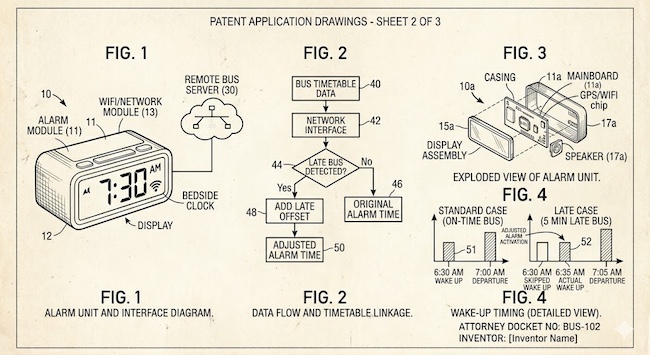
Tip: use Nano Banana to create good quality patent drawings. This is what Nana Banana created using the prompt “Give me patent drawings for an alarm that is linked to a bus timetable so that, if the bus is late, the alarm wakes me up later“:
Step 5:
Register on the GlobalIPCo system and file the provisional patent application with CIPC for only $49. Alternatively, file the provisional patent through Iptica for $99.
You can trust GlobalIPCo and Iptica – they have been the largest filers of South African patents since 2022, and are the #1 choice for inventors who draft their own provisional patents.
If you need help, see our guide on how to file a patent using the GlobalIPCo system.
What do I do next?
After filing the provisional patent, you can mark your product / software “Patent Pending“.
In 12 months’ time, engage a patent attorney (anywhere in the world) to draft and file a provisional patent that claims the date of your provisional patent filed by GlobalIPCo.
Example: What ChatGPT drafted
Below is the patent specification that ChatGPT wrote based on the prompts in steps 2 and 3. Note that ChatGPT even broadened the narrow description of the invention provided. For example, it expanded the reference to “buses” to include “trains, subways, ferries, ride-share services, or other transportation modes”. You have to admit that it’s a rather good and affordable option to start the patent process
System and Method for Dynamically Adjusting Alarm Times Based on Real-Time Transit Arrival Data
Field of the Invention
The present invention relates generally to alarm and scheduling systems, and more particularly to software-based alarm systems that dynamically adjust wake-up times based on real-time public transportation arrival data.
Background of the Invention
Alarm clocks and alarm applications are widely used to wake individuals at predetermined times. Separately, public transportation systems such as buses provide scheduled timetables and, in some cases, real-time arrival estimates through mobile applications or data feeds.
However, existing alarm systems operate independently of real-world transportation conditions. Users typically set alarms based on static schedules or assumptions about transit arrival times. When a bus arrives earlier or later than expected due to traffic, weather, or operational delays, the user may wake too early, unnecessarily reducing rest, or too late, causing them to miss their intended transportation.
Although real-time transit tracking systems exist, there is currently no solution that automatically integrates real-time bus arrival data with an alarm system to dynamically adjust a user’s wake-up time. As a result, users must manually monitor transit updates or set conservative alarms that reduce efficiency and convenience.
Accordingly, there is a need for an alarm system that automatically adjusts wake-up times based on real-time public transportation arrival information.
Summary of the Invention
The present invention provides a system and method for dynamically adjusting an alarm time based on real-time arrival data of a selected bus or other public transportation vehicle.
In one embodiment, a user selects a specific bus route, stop, or trip, along with a desired buffer time needed to prepare and reach the stop. The system continuously or periodically monitors real-time arrival data for the selected bus. If the arrival time changes, the system automatically recalculates and adjusts the alarm time accordingly, without requiring user intervention.
The invention improves convenience, accuracy, and efficiency by ensuring that users wake at an optimal time based on actual transportation conditions rather than static schedules.
Brief Description of the Drawings
(Optional)
- FIG. 1 illustrates a system architecture for dynamically adjusting an alarm based on real-time transit data.
- FIG. 2 illustrates a flowchart of a method for updating an alarm time in response to changes in bus arrival time.
Detailed Description of the Invention
In one embodiment, the invention is implemented as a software application executing on a user device such as a smartphone, tablet, wearable device, or computer. The application may function independently or as part of an operating system alarm feature.
The system includes:
- an alarm module configured to set and trigger alarms;
- a transit data module configured to obtain real-time arrival data for a selected bus;
- a calculation module configured to determine an optimal wake-up time based on the arrival data and user-defined parameters.
The user initially selects a bus route, stop, or specific bus trip, along with a desired preparation buffer time representing the amount of time required to wake up and reach the bus stop.
The transit data module retrieves real-time arrival information from a transit authority data feed, application programming interface (API), or other data source. The system periodically monitors this data at predefined intervals or in response to detected changes.
If the real-time arrival time of the selected bus changes, the calculation module recalculates the required wake-up time by subtracting the buffer time from the updated arrival estimate. The alarm module then automatically updates the alarm time accordingly.
In one embodiment, if the bus is running late, the alarm time is delayed. If the bus is running early, the alarm time is advanced. The adjustment may occur silently or with user notification.
The system may include safeguards such as minimum or maximum alarm times, user confirmation thresholds, or fallback alarms based on scheduled arrival times.
Alternative Embodiments
In other embodiments:
- The system may be used with trains, subways, ferries, ride-share services, or other transportation modes.
- The invention may support multiple alarms linked to different routes or days.
- Predictive algorithms or historical data may be used to supplement real-time arrival data.
- The system may operate in the background or as part of a smart home or wearable ecosystem.
- The invention may be implemented as a method, a system, a device, or a computer-readable medium.
Example Use Case
A commuter selects their usual bus route and sets a 30-minute preparation buffer. Overnight, traffic causes the bus to run 15 minutes late. The system detects the delay and automatically shifts the alarm later, allowing the user additional sleep while still waking in time to catch the bus.
Advantages of the Invention
- Automatically adapts to real-world conditions
- Reduces unnecessary early wake-ups
- Decreases missed transportation events
- Improves user convenience and sleep efficiency
- Eliminates manual monitoring of transit updates